

Intent is not enough: how to apologize for real
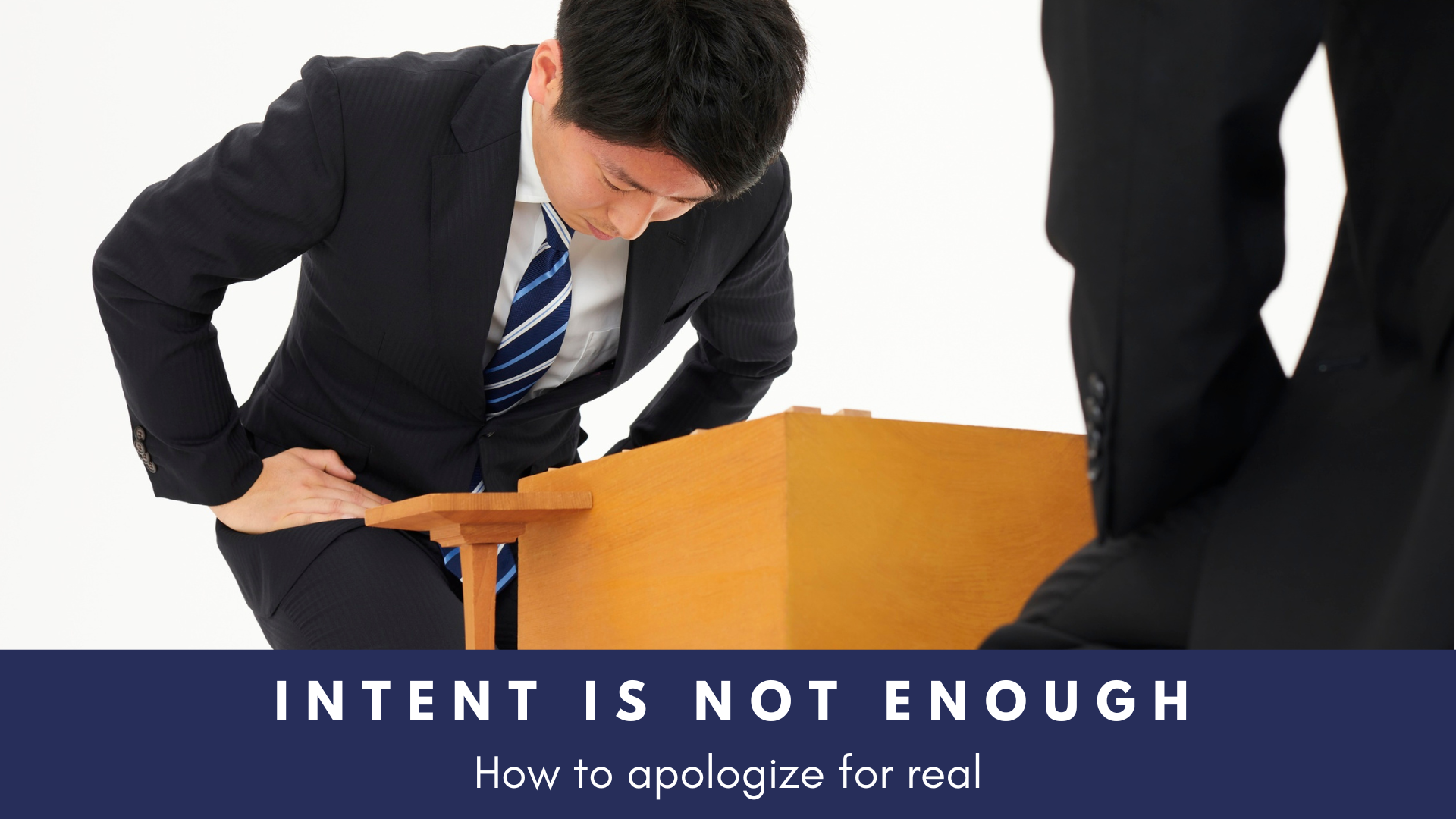
When explanation replaces apology
Last week, an acquaintance said something that cut me hard. Completely taken aback, I told her she had hurt my feelings.
She immediately went into explanation mode, defending her intent. Then she asked if I would forgive her. But she had failed to apologize or acknowledge the harm she caused.
You cannot leapfrog over responsibility and land in forgiveness.
Reconciliation requires us to pause and sit with the discomfort of knowing we’ve caused pain. We need to acknowledge impact before seeking release from it. I told her I needed time.
That exchange is not the first time someone has justified a hurtful comment to me by going into explanation mode. And a much more harmful incident, on a larger scale, happened yesterday at the BAFTA Awards.
A missed opportunity on a global stage
As Delroy Lindo and Michael B. Jordan were presenting, John Davidson (who has Tourette’s syndrome) shouted the N-word. Host Alan Cumming quickly explained the condition and thanked the audience for helping create a respectful space for everyone.
But respectful for whom?
Two Black men had just been subjected to one of the most violent slurs in the English language. The moment moved on without anyone directly acknowledging the harm done to them. Later, the BBC issued a weak apology for airing the segment, though other interruptions had been edited out.
Explanation came swiftly. Accountability did not.
Tourette’s may explain behavior. It does not erase impact. And impact is where apology begins.
Davidson waited several hours before responding to the situation, then saying that his tics did not reflect his personal beliefs and he was "deeply mortified if anyone considers my involuntary tics to be intentional or to carry any meaning." He expressed appreciation to the audience for their understanding, saying “I have spent my life trying to support and empower the Tourette’s community and to teach empathy, kindness, and understanding from others and I will continue to do so.”
Yet “empathy, kindness, and understanding” needs to apply both ways. He still failed to acknowledge the pain he caused to these esteemed Black actors by uttering such a deeply hurtful word.
Intent does not equal impact
In diversity, equity, and inclusion work, we return again and again to a simple truth: intent does not equal impact.
Most people do not intend to cause harm. But that doesn’t matter to the person who receives the impact of a racist/homophobic/misogynist/ableist comment. Impact matters more than intent.
If someone steps on your foot and says they did not mean to, the absence of malice does not remove the bruise. If I misgender someone and then explain I didn’t mean to cause harm, it doesn’t erase the hurt.
Our best intentions do not excuse the impact of a harmful statement.
What a real apology looks like
So what does an apology that actually repairs look like?
1. Name the harm clearly.
Not “I’m sorry you felt hurt.”
Instead, use words like: “I’m truly sorry I _______. I was wrong.” “I made a mistake and I take full responsibility.” “I will work to do better in the future.” "I know I can't undo what I did, but I want to make it up to you. What can I do to help?" "Thank you for bringing this to my attention. I apologize for the oversight, and I'll make the necessary corrections right away."
2. Resist the urge to defend your intent.
This is the hardest part for most of us and where Davidson’s statement fails. When someone tells us we have hurt them, we want to explain and clarify to justify ourselves. But explanation often lands as dismissal.
“I didn’t mean it that way.” “That’s not what I was trying to say.” “You misunderstood.”
All of those responses center your innocence instead of the listener’s experience.
Repair cannot begin if your first move is self-protection. It begins when you are willing to stay with the impact long enough for the other person to feel heard.
When someone is in pain, they are not asking you to prove your character. They are asking you to acknowledge their experience.
3. Express remorse without conditions.
No qualifiers. No ifs, ands, or buts. Do not expect anything in return from the person you hurt or offended. They do not owe you anything.
4. Take responsibility.
This is where apology often unravels. We might start strong and then soften with excuses.
“That’s just how Tourette’s works.” “I was exhausted.” “I’d had too much to drink.” “It’s been a stressful week.”
All of that may be true, but taking responsibility means owning your part.
5. Ask what repair looks like.
An apology can be the beginning of repair, but we must relinquish control of the outcome.
Often after we say “I’m sorry,” we want to return to normal. But the person who was hurt may need space, a public acknowledgment, changed behavior, or just simply being heard.
Instead of assuming you know what will fix it, you might say, “What would feel meaningful to you right now?” or “How can I make this right?” And then you listen to understand.
6. Release the demand for immediate forgiveness.
Forgiveness is a gift, and immediate reconciliation rarely happens. You need to give the other person time and space.
Apology as a relationship, not a liability
When I lived in Japan I was struck by how often Japanese people apologize for small inconveniences, minor disruptions, and things that barely seem worth mentioning. Even the historical tradition of hara-kiri (ritual suicide) is about apologizing and saving face for the good of the whole.
In Japan apology is less about admitting moral failure and more about preserving relationship.

Words like “sumimasen” carry humility and acknowledge that something has disrupted harmony, even if intent was innocent.
The focus is not on winning the argument. It is on restoring balance.
But for Americans, apology can feel like liability. If we say we’re sorry, we are admitting guilt. So we explain, justify, and defend our intent.
But what if apology were less about protecting ourselves and more about protecting the relationship?
Returning to the moment
I keep coming back to that moment at the BAFTA Awards. Explanation and excuses arrived swiftly. But understanding a neurological condition does not excuse the need to address harm.
These two men starred in a brilliant movie celebrating Black history and music, “Sinners.” The film won BAFTA accolades. But they had to move on immediately after a racial slur was hurled at them. During Black History Month. What if they’d received a simple acknowledgement that they’d been harmed?
An apology would not have erased the slur or undone centuries of history attached to it. But it would have signaled something essential: we see the impact. We name it. We are sorry.
That is what repair looks like in real time. And it is what we owe each other, whether in living rooms, locker rooms, or global stages. Intent is not enough. Impact is where we begin.
Let’s make your message the one they remember. Fertile Ground Communications transforms complex ideas into clear, compelling messages that capture attention and inspire action. Whether you’re a small business, public agency, or nonprofit, we help your voice break through the clutter and connect authentically with your audience.
